Build your company like software: deep modules on a strong core
An AI-native company needs a tool-agnostic core and business divisions built as modules on top.
 Nick Pinidiya
Software engineers manage complexity with deep modules: a simple front that hides a lot of work. Build an AI-native company the same way, with a strong core that isn't tied to any one vendor and each division as a module on top.
An example company as software
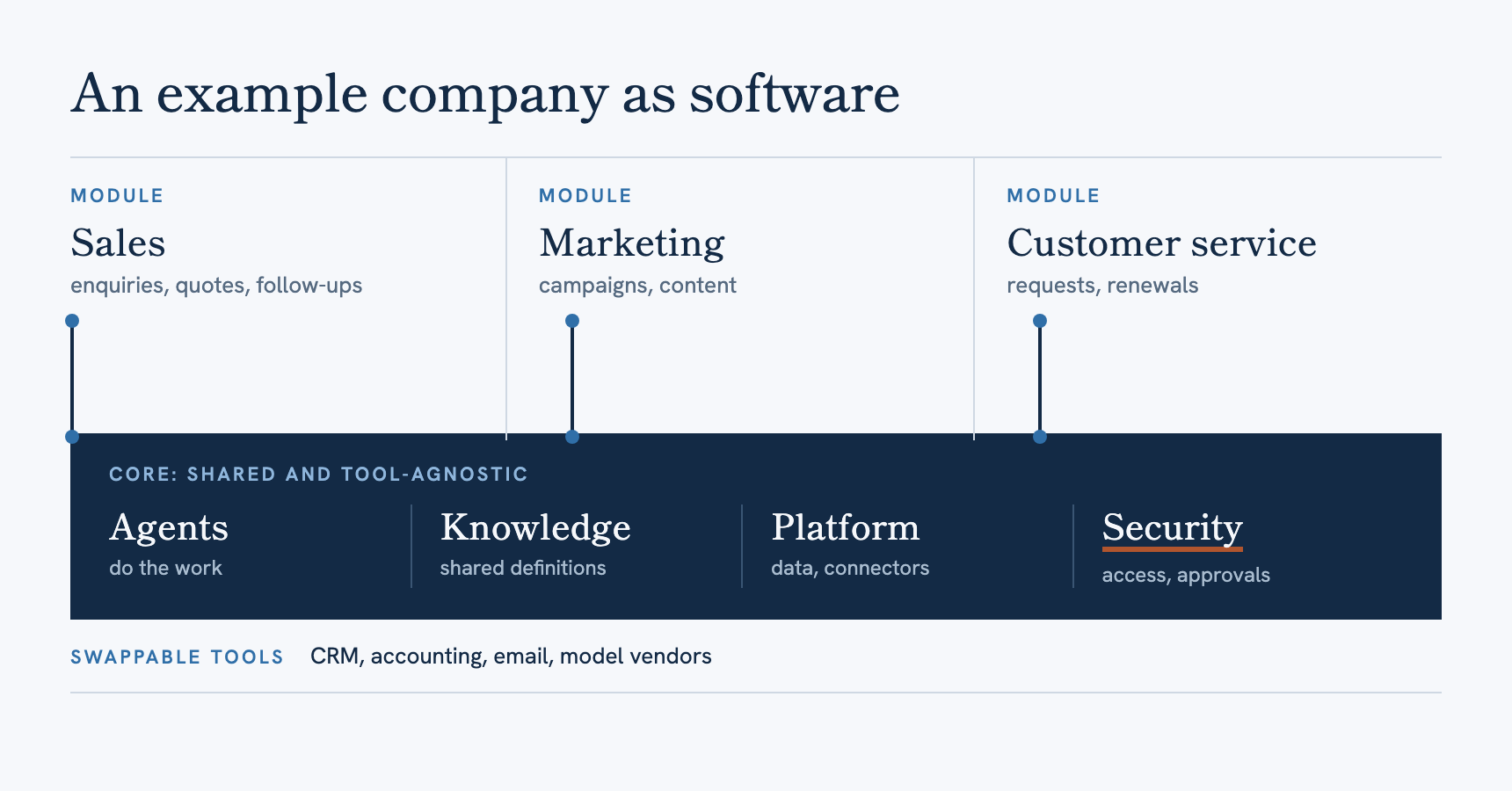
Deep modules. John Ousterhout's term for a module with a simple interface that hides a lot of work. A shallow module makes you learn nearly as much as it does for you. Most company processes are shallow. A handover needs a form, three people and a spreadsheet to explain it. In an AI-native company you state the outcome and the rules. Agents do the steps, and a named person signs off.
A strong core. Everything shared goes here: the agents, the knowledge (wiki, records, decisions) and the platform (identity, data, connectors to outside tools) and security (who can see and approve what). Don't tie it to one vendor. BCG's enterprise-as-code work stresses portability and avoiding lock-in. Bain adds shared business definitions and governed data access, so every agent works from the same meaning. If you can swap your CRM or your model vendor without touching a division, the core works.
Divisions as modules. Take an example company (an illustration, not a client). Sales is a module: it qualifies enquiries, drafts quotes and chases follow-ups. Marketing is a module: it plans campaigns and writes content. Customer service handles requests and renewals. Each one talks to the core through a narrow interface, such as "read this contact" or "draft this quote for approval". None of them owns the contact record, the rules or the connectors.
We run qubit this way: business development, software and consulting are modules on one core.
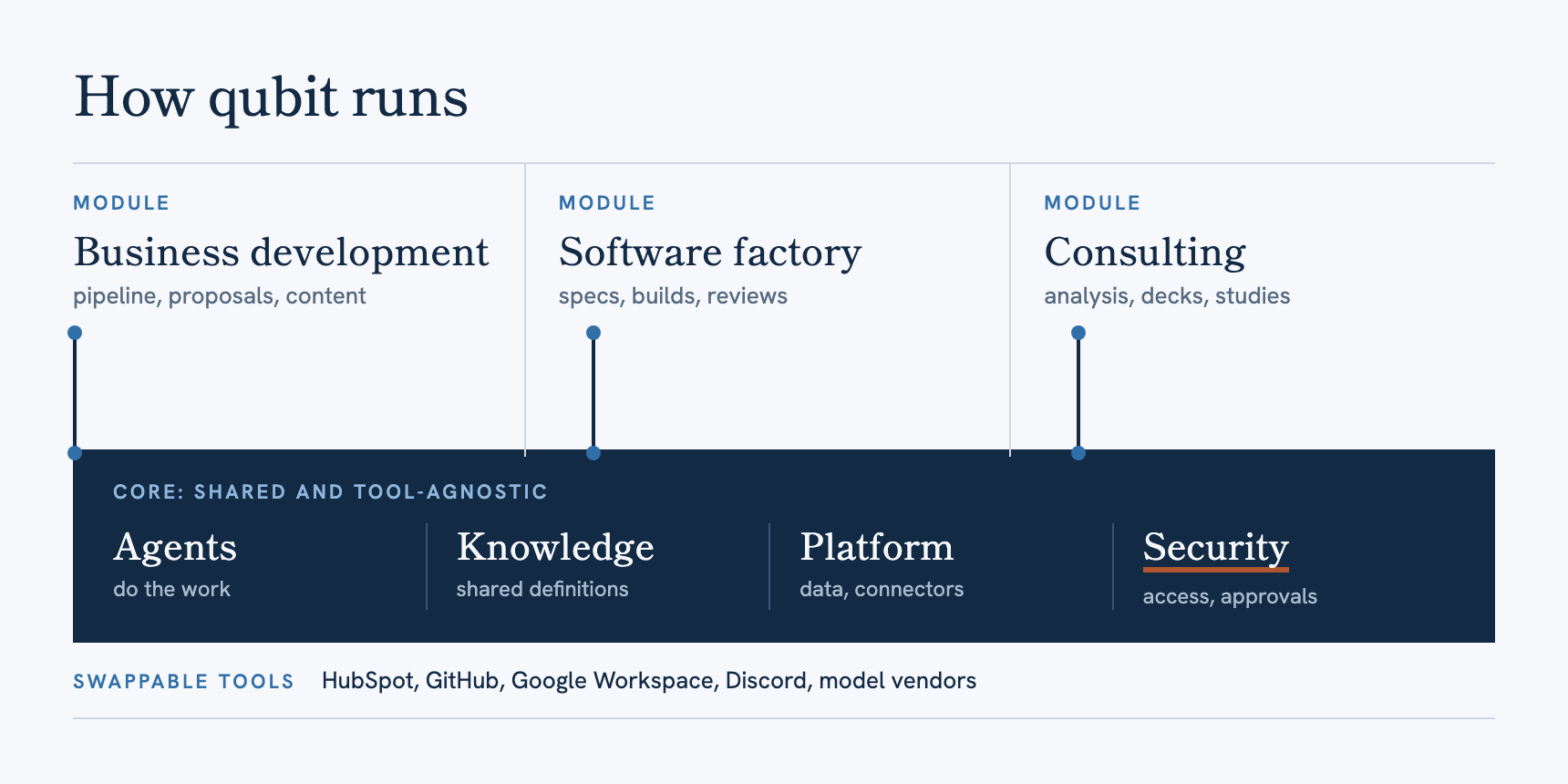
Why it matters for leaders. The core is where agents and people share one picture of the company: the same definitions of a customer, a deal and a job. Agree them once and both reason about the business the same way. Divisions hand data to each other at clear seams, the points where work changes hands. Each seam has an owner, a fixed format and a person who signs off. You can see where information moves and where a person approves it. You can also add or retire a division without a rebuild.
Do this Monday: draw your company as modules on a core. Does it match this one?
More on how we think: qubit's beliefs.